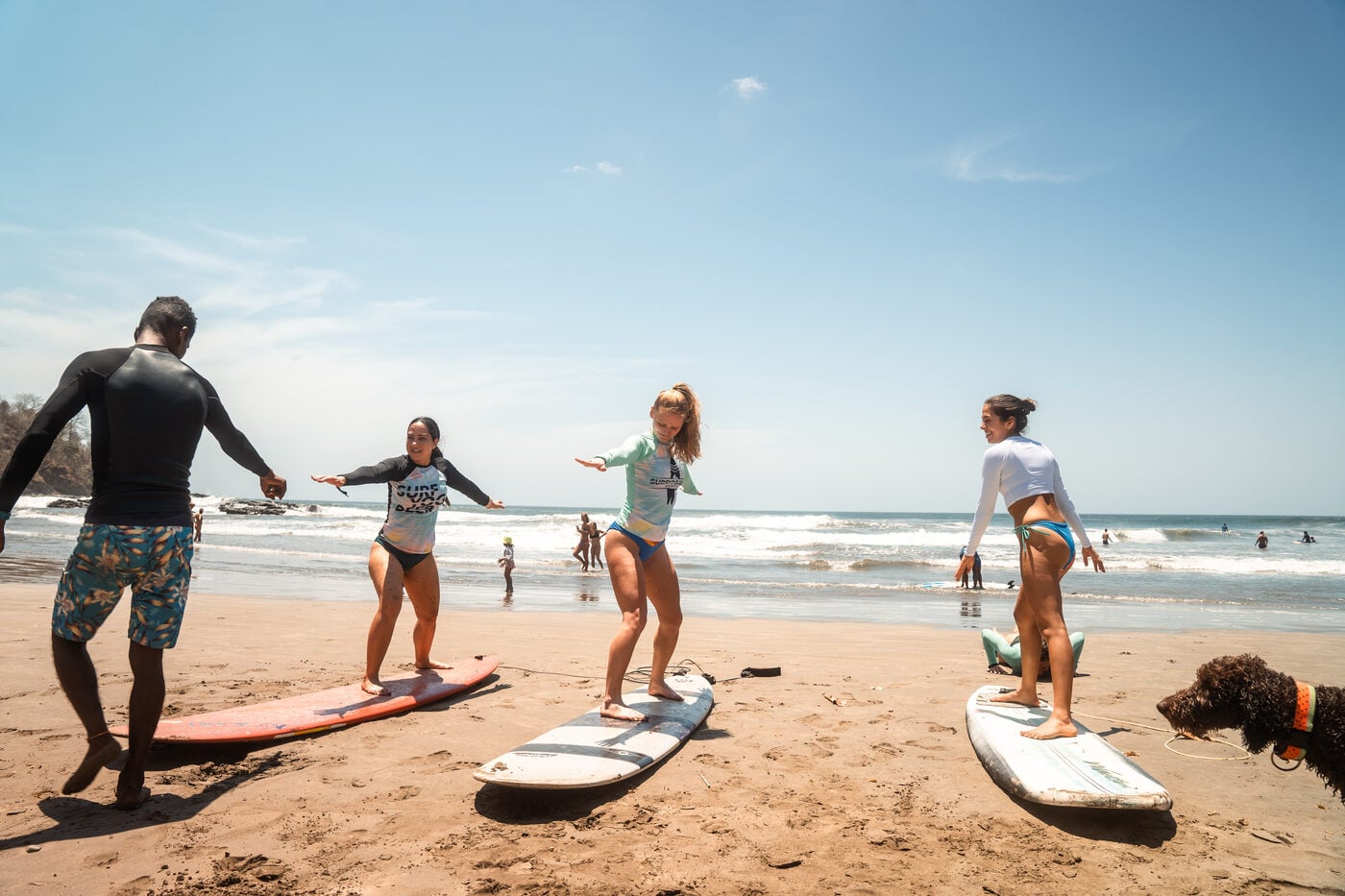
Surfers walking down the sand toward the beach break at Playa Maderas, Nicaragua
Nicaragua · San Juan del Sur

HOW YOU GET TO
PLAYA MADERAS.

Two airports, one land border, one dirt road, and a beach that has somehow stayed small. Here is the whole journey, honestly, including the parts nobody else writes down.

The short version

Playa Maderas sits about 20 minutes north of San Juan del Sur on Nicaragua's Pacific coast. You get there from one of two airports.

Managua (MGA) is about two and a half hours by road, all inside Nicaragua, no border. It is the simpler day.

Liberia, Costa Rica (LIR) is about three hours of driving plus a land border crossing at Penas Blancas. It usually has more direct flights from the US and cheaper fares, and it costs you roughly 14 US dollars in cash to enter Nicaragua and 4 dollars to leave, plus one to two hours at the border.

Both routes finish on the same rough dirt road down to the sand. Most transfers put you in a 4x4 for that last stretch.

01

WHY ANYONE BOTHERS
GOING THERE.

Maderas is a beach with a road problem, and the road problem is the whole point.

It is a horseshoe of sand tucked between two headlands, backed by dry tropical forest, facing straight west into the Pacific. The wave is a sand-bottom beach break that throws up A-frame peaks, rights that peel and lefts that are a bit more of a mess. It is forgiving enough to learn on in the dry season and good enough to keep intermediate surfers busy the rest of the year.

What is actually there: one loose row of places to eat and sleep, a few board racks, a couple of bars with sand floors, and a hill of jungle behind it. That is the list. No strip, no resorts, no traffic, no cruise ships, nobody selling you a timeshare.

The sunsets are the thing people talk about afterwards. It faces due west and the north headland frames the sun as it drops, which is why half the beach stops what it is doing around five thirty.

The honest part: Maderas is not undiscovered. Shuttles run down from San Juan del Sur all day and it gets genuinely crowded in the water mid-morning, especially in the dry season. It has stayed small because the road in is too rough to put a big hotel at the end of, not because nobody found it. Come early, surf the dawn, and you get the empty version.

Horses on the empty sand at Playa Maderas with jungle behind the beach
The beach north of the main peak, early. This is what the road protects.
02

THE TWO AIRPORTS,
AND HOW TO CHOOSE.

There is no third option. Nicaragua has one international airport worth flying into, and Costa Rica has one that is close enough to be worth a border.

Managua, Nicaragua (MGA)Liberia, Costa Rica (LIR)
Time to MaderasAbout 2.5 hours, all roadAbout 3 hours of road, plus 1 to 2 hours at the border
Border crossingNoneYes, on foot, at Penas Blancas
Flights from the USFewer direct options, usually connecting through Miami, Houston, Panama City or San SalvadorPlenty of direct flights, including from New York, Boston and other east coast hubs
Typical fareOften the pricier of the twoOften meaningfully cheaper, which is the entire reason people do it
Border cash neededNoneAbout 14 US dollars in, about 4 out, small bills
Best forFirst trip, late arrivals, anyone who would rather not spend an afternoon walking a passport between two countriesSaving money, better flight times, and not minding an adventure on day one
The rule of thumb

If the fares are close, fly Managua. You will be on the beach two hours earlier and nothing can go sideways at a border you never visit.

If Liberia saves you real money or turns a connection into a direct flight, take it. Thousands of people cross at Penas Blancas every week and it is completely routine. It is just longer, hotter and cash-only, and you should know what it looks like before you are standing in it. That is the next section.

03

THE LIBERIA BORDER
CROSSING, IN FULL.

Most guides describe this in one sentence and call it easy. It is not hard, but it is four separate legs, you are on foot in the middle, and your bags do not stay in the vehicle. Here is exactly what happens.

01

Liberia airport to the border

About an hour on paved road, in a Costa Rican vehicle. Straightforward. That driver cannot cross into Nicaragua, so this vehicle ends at the border and does not come with you.

02

Penas Blancas, on foot

You get out, you take everything with you, and you walk. Costa Rica stamps you out first. Then there is roughly half a mile of open road between the two checkpoints that you cover on foot, in the sun, with your luggage. Then Nicaragua checks your passport, takes your money, and scans your bags.

Porters are there and they are worth it. They work with handcarts and charge about 5 to 10 US dollars per cart. Agree the number before they load anything. There are free bathrooms at either end of the Costa Rica building, and they are the last reliable ones for a while.

Budget one to two hours. Weekends, public holidays and the run-up to Christmas are slower. The line can be long. Your driver will help you through it.

03

The border to the coast

A second, Nicaraguan vehicle picks you up on the far side and runs you down past Rivas toward San Juan del Sur. Roughly an hour and a bit. This is the leg where somebody usually has cold drinks waiting and everybody stops being tense about the border.

04

The last stretch to Maderas

The final 20 minutes leaves the pavement outside San Juan del Sur and drops onto dirt. It is rutted, steep in places, and crosses a couple of creek beds that hold water in the rainy season. Most operators hand you to a third vehicle, a 4x4, for this part. That is normal. Nothing has broken and nobody has forgotten you.

The money, specifically

This is the part that catches people out. The border runs on US cash. Cards are not a reliable option, there is no ATM you want to depend on, and officers rarely have change.

~$14To enter Nicaragua. Roughly 1 dollar at the door as a municipal fee, then about 13 at the counter for the tourist card and border services.
~$4To leave Nicaragua on the way home. About 1 dollar municipal plus about 3 dollars migration.
Bring it in ones and fives

Carry about 50 US dollars per person in small bills, set aside and untouched, purely as border money. Handing a fifty to a window that cannot break it is the single most common way to lose twenty minutes here.

Two extra fees exist that most people never pay. Costa Rica charges an exit fee if you have been staying in Costa Rica before you cross, and an entry fee if you come back and overnight there on the way home. Fly in and cross the same day and you will usually skip both.

Have these in your hand, not your bag

Passport. The cash, already counted. The name and address of where you are staying, because the form asks for it. Your flight out of the country. And a pen, which sounds ridiculous right up until you are the one person in the queue without one.
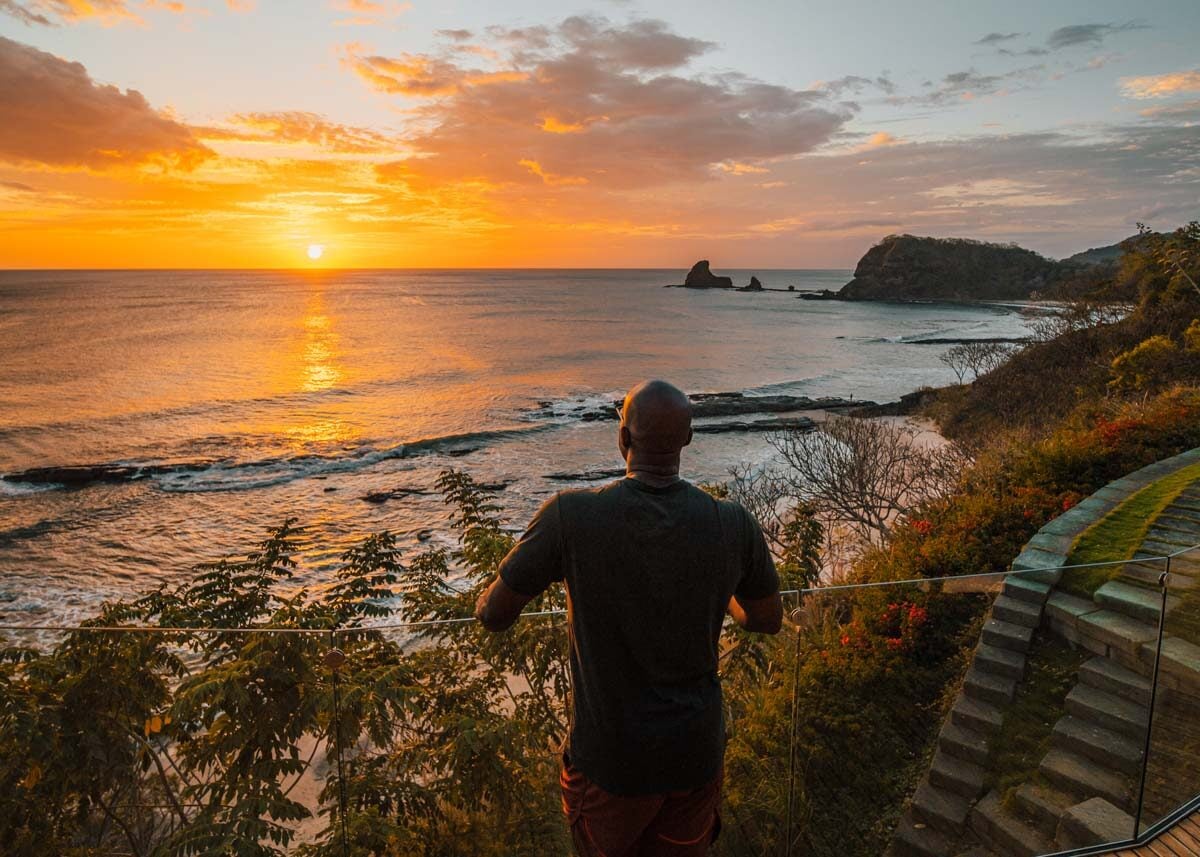
Looking down over the coast road toward Playa Maderas at sunset
The payoff for the afternoon. The road down, about five minutes from the beach.
04

AIRPORT TO SAND.
WHAT IT COSTS.

Four ways to do it from either airport, priced roughly. Costs move, so treat these as the shape of the thing rather than a quote.

Shared shuttle

The default

Around 30 to 40 dollars per person from Managua, and around 55 to 70 per person from Liberia on a cross-border service that walks you through the crossing. Fixed departure times, so it only works if your flight lands in the right window. Cheapest sane option.

Private transfer

The flexible one

Roughly 125 to 200 dollars per vehicle depending on the airport and the time of day. A vehicle fits three people with luggage, not four, which is worth knowing before you split it four ways in a group chat. Door to door, on your schedule.

Taxi

Managua only

Doable from Managua if you agree the price and the currency before you get in. Not worth it from Liberia, because a taxi cannot cross the border with you and you will be rebuilding the trip on the far side anyway.

Public bus

The long way

Genuinely cheap, genuinely slow. Expect several changes, a stop in Rivas, and a shuttle or taxi at the end. A whole day with bags. Fine if the day is the point.

Getting down to the beach itself

If you are based in San Juan del Sur and going to Maderas for the day, shuttles run down and back several times a day for a few dollars each way, and a taxi runs about fifteen for the vehicle. If you are staying at Maderas, whoever you are staying with will almost always sort the last leg. Ask before you book a separate transfer.

About that road: a normal sedan can make it in the dry season and will regret it in the wet one. That is why the 4x4 handoff exists, and why nobody rents a small car for this.

05

VISAS, PASSPORTS
AND ENTRY.

US passports

Nothing to apply for

A US passport gets a tourist visa on arrival. You buy it at the window when you land or cross. There is no form to fill in beforehand and no embassy to visit.

Everyone else

Check your own rules

Not every passport has it this easy. Some nationalities need a visa arranged in advance. Check your own country's requirements rather than assuming the American answer applies to you.

Non negotiable

A flight out of the country

They ask for it, at the airport and at the border. Have it on your phone. If you fly home out of a different country than the one you entered, be ready to explain how you are getting to that airport.

Two more things

Passport validity. Six months beyond your travel dates is the standard ask. Check the expiry date now, not the week before.

The CA-4. Nicaragua, Honduras, El Salvador and Guatemala share a single 90 day zone, and time in any of them counts against the same 90 days. Time in Costa Rica does not. Irrelevant for a one week trip, useful if you are moving around the region.

06

THE PRACTICAL
STUFF.

Power

Nicaragua runs on 120 volts with the same flat two-prong and three-prong plugs as the US. Coming from the States or Canada, bring nothing. Coming from Europe, the UK or Australia, bring an adapter. Power at the beach can blink during storms, so charge things when you think of it.

Money

The currency is the cordoba, but US dollars are taken almost everywhere on this coast. Pay in dollars and your change usually comes back in cordobas, which is fine. Bring clean, untorn small bills. Nobody wants your worn twenty.

ATMs

There is no ATM at Playa Maderas. The machines are up in San Juan del Sur. Draw what you need before you come down, because the only thing worse than the road in is doing the road in twice for cash. Cards work at some places at the beach and not at others. Do not plan around them.

When the surf is good

There are waves year round. The size depends on the season, and the two seasons work against each other.

May to October is the big one. South and southwest swell out of the deep Pacific, the most consistent and biggest surf of the year. It is also the rainy season, so the trade-off is real.

November to March is smaller and cleaner, with offshore wind most mornings and long sunny stretches. This is the window if you are learning, or if you want the best conditions rather than the biggest ones. It is also the busiest.

Whatever the month, the wave is best early. The wind comes up, and so does everybody else.

If you are picking a month rather than a route, we broke the seasons down properly in the best time to surf Nicaragua.

The weather, plainly

Dry season, roughly November to April. Hot, hard sun, almost no rain, offshore wind, hills going brown and dusty. Reliably beautiful and reliably busy.

Green season, roughly May to November. Rain, but usually in short heavy afternoon bursts rather than all day. Everything is green, the swell is bigger, and there are far fewer people. September and October are the wettest.

It is hot all year. Reef-safe sunscreen, a hat, and more water than you think.
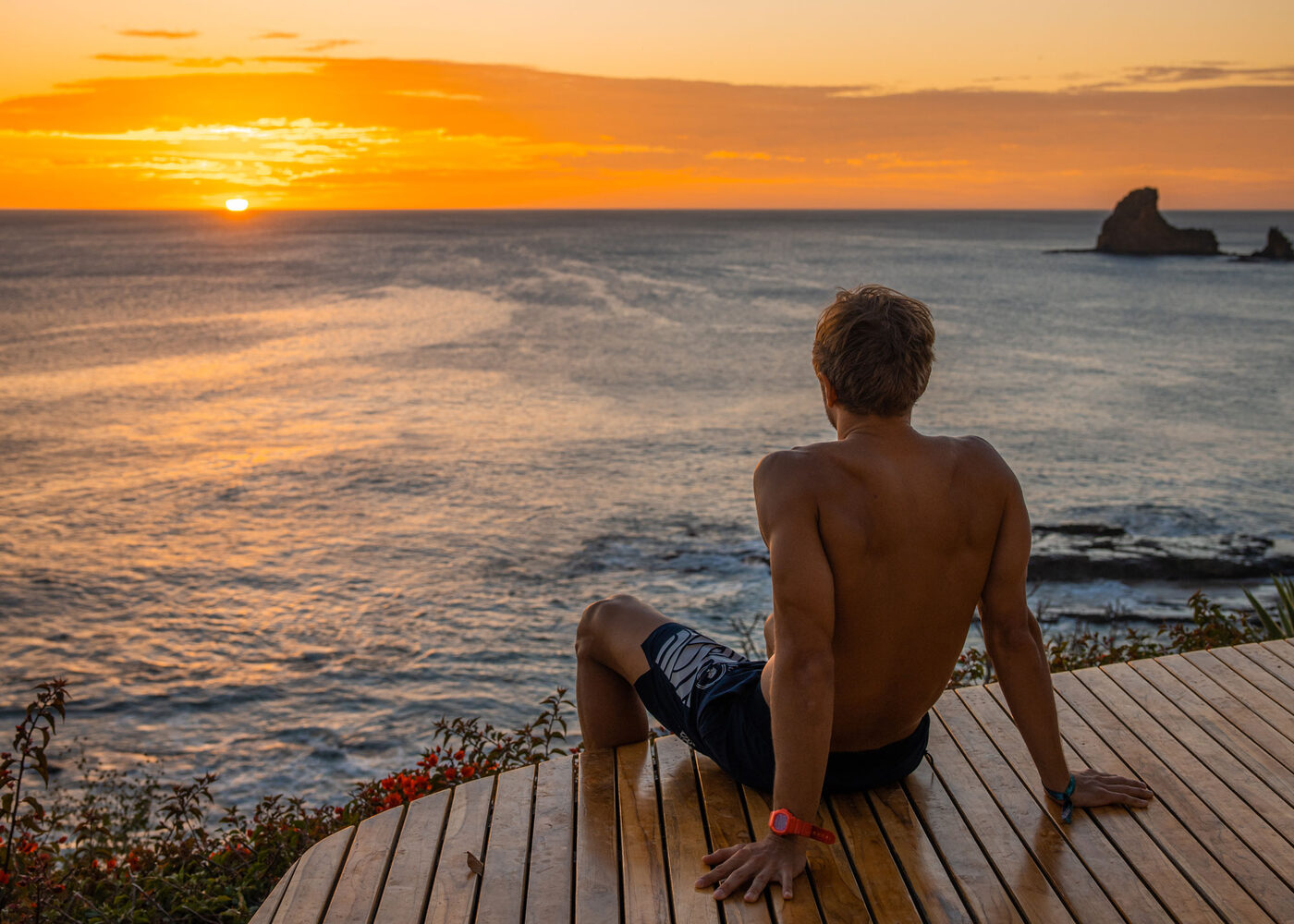
Watching the sun set over the Pacific from a deck above Playa Maderas
Around five thirty, most days, most of the year.
07

QUICK
ANSWERS.

How far is Playa Maderas from San Juan del Sur?

About 20 minutes by road, roughly 9 kilometres north. The first part is paved and the last stretch is dirt.

Should I fly into Managua or Liberia?

Managua if the fares are similar, because there is no border and you arrive about two hours sooner. Liberia if it saves you real money or gets you a direct flight, and you are happy to spend one to two hours crossing at Penas Blancas with roughly 14 US dollars in cash.

How much does it cost to cross the border into Nicaragua?

About 14 US dollars per person to enter, made up of a municipal fee of about 1 dollar and about 13 dollars at the immigration counter. Leaving costs about 4 dollars. US cash only, in small bills, because officers rarely have change.

Do my bags stay on the shuttle at the border?

No. You take everything with you and carry it about half a mile between the two checkpoints on foot. Porters with handcarts work the crossing and charge about 5 to 10 US dollars per cart. Agree the price before they load.

How long does the Penas Blancas crossing take?

Usually one to two hours. Longer on weekends, public holidays and around Christmas and New Year.

Do I need a visa for Nicaragua?

US passport holders get a tourist visa on arrival with nothing to arrange in advance. Other nationalities should check their own country's requirements. Everyone is asked to show a flight out of the country, and passports should be valid for six months beyond your dates.

Is there an ATM at Playa Maderas?

No. The nearest ATMs are in San Juan del Sur, 20 minutes away. Bring cash down with you.

Do I need a plug adapter?

Not if you are coming from the US or Canada. Nicaragua uses the same 120 volt supply and the same flat pin plugs. From anywhere else, yes.

When is the best time to surf Playa Maderas?

May to October for the biggest and most consistent swell, which is also the rainy season. November to March for smaller, cleaner waves, offshore mornings and dry weather, which is the better window for learning. Early morning on any day of the year.

Can I drive myself there?

You can drive to San Juan del Sur easily. The last stretch to Maderas is rough dirt with creek crossings, and a low-clearance rental will struggle, especially in the wet season. A rental car hired in Costa Rica cannot cross the border with you at all.

08

WE HAVE DONE
THIS RUN A LOT.

Everything above is the version we give our own guests, because we have been putting groups on that dirt road since 2015 and we have watched every way the day can go.

If you are going independently, take the page and go. That is what it is for.

And if at some point you would rather somebody else handled the shuttles, the border, the 4x4 and the part where you arrive somewhere you have never been with nowhere to sit, that is the thing we do. Small groups, around fourteen people, Playa Maderas, all winter.


See our Nicaragua trips

A surfer riding a wave at Playa Maderas while two people watch from the water Two people practising yoga in silhouette at sunset above the Pacific in Nicaragua